
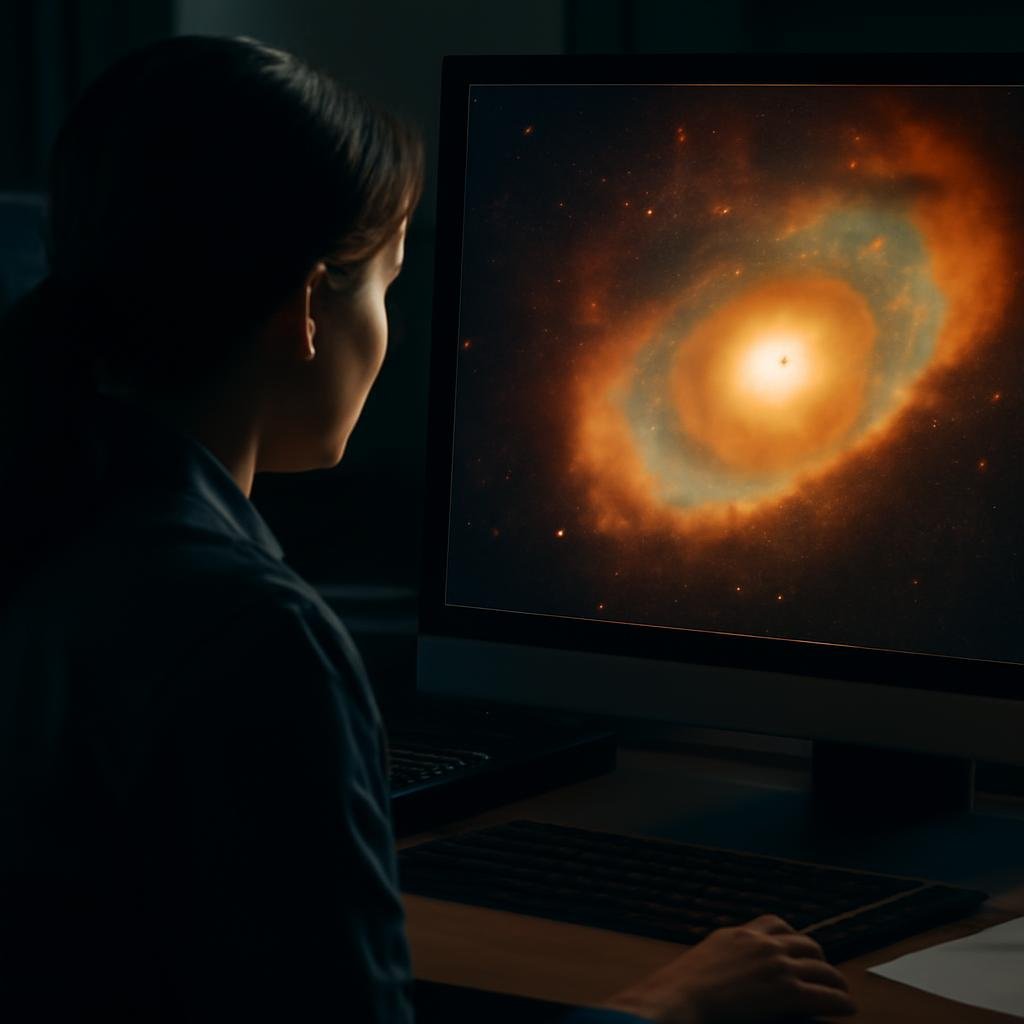
The European Space Agency's Euclid space telescope has achieved a remarkable milestone by discovering 31 ancient quasars, among the earliest known to science. These quasars, which are extremely bright and powered by supermassive black holes, offer a glimpse into the universe's early days. The two most ancient of these quasars shone with light equivalent to that of a trillion suns when the universe was only about 670 million years old, which is a mere 5% of the universe's current age.
This discovery is significant not only for understanding the formation and evolution of galaxies but also for comprehending the age and expansion of the universe itself. Quasars are among the brightest objects in the cosmos, and their incredible luminosity allows astronomers to study them across vast distances. The light from these ancient quasars has traveled billions of years to reach us, making them invaluable sources of information about the conditions of the early universe.
Previous studies have focused on quasars in different epochs, but the Euclid telescope, designed to explore dark energy and dark matter, enables astronomers to observe these objects in unprecedented detail. By analyzing the characteristics of these newly discovered quasars, researchers hope to gain insights into the black hole growth, cosmic structure formation, and the radiation emitted in the early universe.
This finding comes at a crucial time in astronomical research, as it lays a foundation for future investigations into the behavior of quasars and their influence on their host galaxies. The Euclid telescope is expected to continue providing data that enhances our understanding of the cosmos and its origins.
In conclusion, the discovery of these ancient quasars by the Euclid space telescope marks a landmark achievement in the field of astrophysics. It not only contributes to our knowledge of the universe's infancy but also opens up new avenues for research regarding the evolution of galaxies and black holes over cosmic time.
Was this article helpful?