
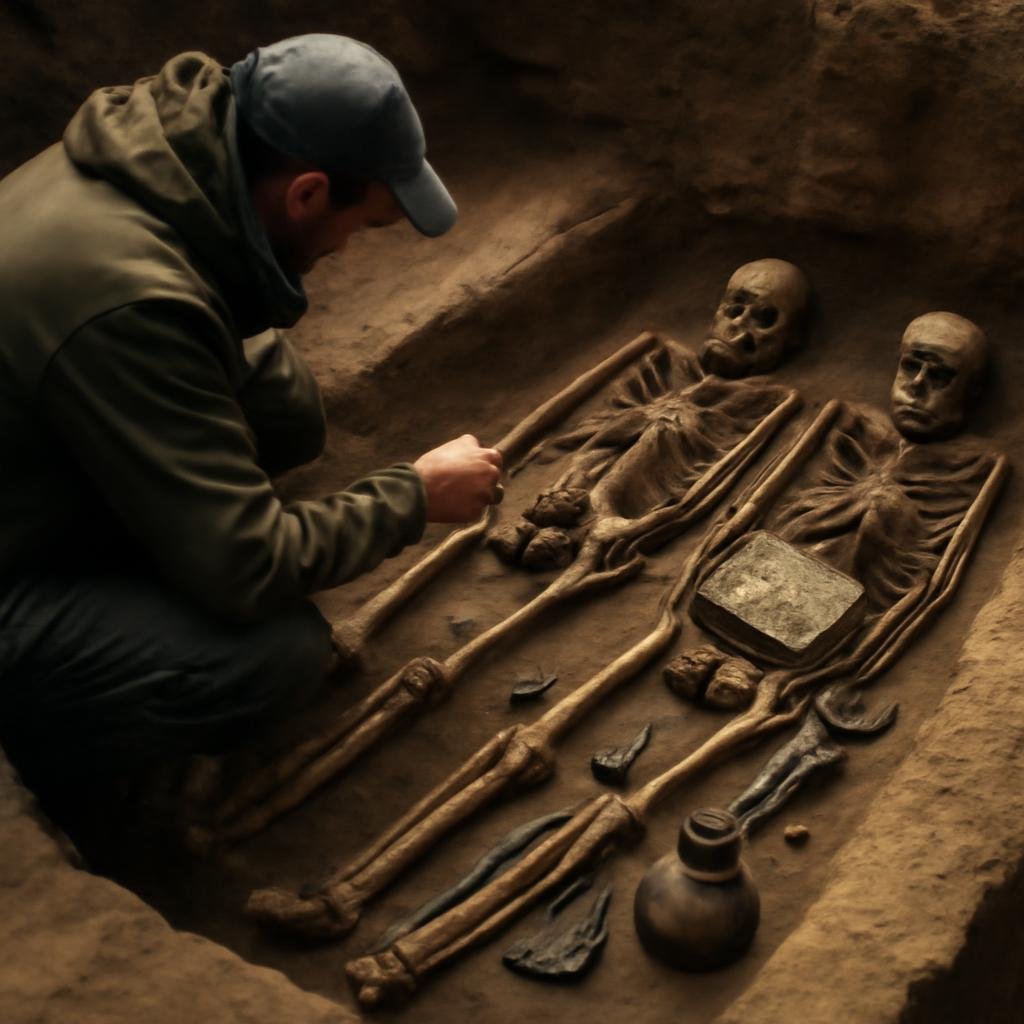
A groundbreaking study published in *Science Advances* on July 3, 2026, has revealed significant new insights into the burial practices of the Scythian elite across the Eurasian steppe. Researchers combined the fields of archaeology, anthropology, and genetics to present evidence that suggests the political power among these ancient nomadic elites was grounded in inherited family lineages linking multiple burial sites. This study not only enhances our understanding of the Scythians but also provides a broader perspective on the development of social inequality and political authority in prehistoric societies.
The research team focused on elite burial sites, analyzing ancient DNA extracted from the remains interred in these graves. Their findings indicated that individuals from different sites were closely related, which implies that familial connections may have played a crucial role in establishing and maintaining political dominance among the Scythians. By integrating genetic data with archaeological findings, the researchers highlighted how these relationships could transcend geographical boundaries, connecting communities across vast regions. This aligns with theories of social organization among nomadic populations, where family ties could reinforce group cohesion and enhance leadership legitimacy.
Moreover, this discovery prompts a reevaluation of how we perceive social structures in ancient societies. The idea that power could be inherited rather than solely based on merit or wealth changes the narrative surrounding Scythian culture. Traditional views often emphasized individual accomplishments or warrior status; however, this study shifts attention to the importance of lineage and familial networks, suggesting that long-lasting political authority could be traced through blood lines.
In light of these findings, the research stands as a significant contribution to the field of ancient studies. It opens up new avenues for understanding how elite groups constructed their identities and wielded authority in a complex socio-political landscape. As archaeological methods continue to evolve, integrating scientific analysis with traditional exhumation techniques will likely yield more revelations about ancient civilizations.
For those keen on exploring more nuanced perspectives on ancient societies and their governance structures, this study lays a compelling groundwork that intersects genetics, culture, and history.
To delve deeper into this intriguing subject, consider reading the full article at *Phys.org*.
Was this article helpful?